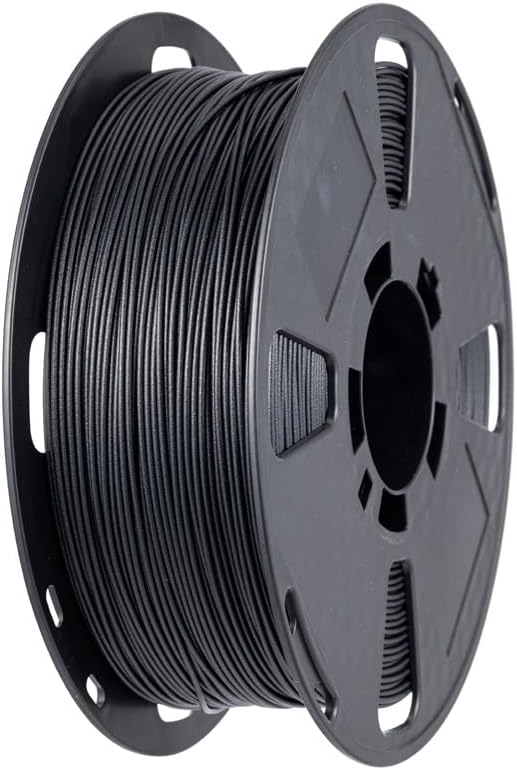
When Standard Engineering Filaments Aren't Enough
There's a category of print that sits beyond what PETG or standard PLA can reliably handle — parts that need to stay stiff under real mechanical stress, survive contact with fuels and solvents, hold their dimensions in heat, and not absorb moisture the moment the humidity climbs. S3DPS PBT-CF was made for exactly those situations.
By combining the inherent toughness and chemical resistance of Polybutylene Terephthalate with carbon fibre reinforcement, PBT-CF delivers a material that serious makers, engineers, and small manufacturers reach for when the application actually demands it — not just when they want something that sounds impressive.
Stiffer, More Precise Prints Thanks to Carbon Fibre
The carbon fibre loading in PBT-CF does what it always does — it stiffens the material, improves dimensional stability under load, and gives printed parts a rigidity that unfilled PBT or PETG simply can't match. If you've printed structural brackets, frames, or load-bearing housings in PETG and found them flexing more than you'd like, PBT-CF is the logical next step. Parts come out with a clean, matte, slightly speckled surface finish that looks machined rather than printed, which matters when a part ends up in a customer's hands or on a vehicle.
Heat Resistance That's Honest About Its Limits
PBT-CF printed parts stay dimensionally stable at temperatures up to approximately 100°C under passive, no-load conditions. That covers a wide range of real-world applications — parts sitting near heat sources, inside warm enclosures, on dashboards, or in proximity to automotive components that radiate heat without directly loading the part.
What it doesn't cover is sustained mechanical loading at high temperature. If a part needs to carry a real load at 100°C or above, you'll want to look at a higher-tier engineering material like PPA-CF or polycarbonate. Being honest about that upfront saves a failed application down the line.
Chemical Resistance That Beats Most CF Options on the Market
This is where PBT-CF genuinely earns its place over PA-CF in a lot of applications. PBT has robust resistance to diluted acids, alcohols, ketones, solvents, oils, and greases. If your parts live in a workshop, sit near a fuel system, or get wiped down with industrial cleaners on a regular basis, PBT-CF handles that environment comfortably — where a Nylon-based CF filament might degrade or absorb contaminants over time.
Low Moisture Absorption — A Real Advantage Over PA-CF
Carbon fibre Nylon is popular, but it comes with a persistent problem — it absorbs moisture aggressively, which means dimensional drift, loss of mechanical properties, and constant battle with storage and drying. PBT-CF has significantly lower moisture absorption, which means printed parts hold their shape and strength in humid environments, outdoors, and in applications where the part will be exposed to water or condensation over its service life. For many applications, this alone makes PBT-CF the smarter choice over the more commonly marketed PA-CF options.
Dry It First — This Step Is Not Optional
Even though PBT-CF absorbs less moisture than Nylon, it is still hygroscopic. A spool that has been sitting in ambient air for a few days will print with bubbling, rough surface texture, poor layer adhesion, and inconsistent extrusion. Dry at 65–70°C for 6–8 hours before printing, and ideally print directly from a filament dryer throughout the job. Leaving an open spool out overnight before a print run is the most common cause of disappointing results with this material — and the easiest to avoid.
You Need a Hardened Steel Nozzle
Carbon fibre is abrasive. Not "mildly wear-accelerating" — genuinely abrasive. A standard brass nozzle will show measurable wear within a few hours of printing CF materials, leading to an enlarged bore, under-extrusion, and increasingly poor print quality. A hardened steel nozzle is not a recommendation here — it is a requirement. If you don't currently have one, sort that out before loading this filament.
An Enclosure Helps, Especially on Larger Parts
PBT-CF doesn't demand an enclosure the way ABS does, but it benefits meaningfully from one — particularly on parts with a wide footprint or tall geometry. A stable ambient temperature around the print reduces internal stress, improves interlayer bonding, and keeps warping in check on the parts where it matters most.
Not for Electrical Insulation
Carbon fibre reduces the electrical resistivity of the material relative to unfilled PBT. Printed parts should not be used as electrical insulation or placed in contact with live conductors.
What Gets Made With PBT-CF?
The combination of CF stiffness, PBT chemical resistance, low moisture uptake, and ~100°C passive heat tolerance makes this filament well-suited for a specific and practical set of applications:
-
Automotive brackets, clips, and housings — parts that live near heat, contact lubricants, or fuels, and need to stay dimensionally accurate over years of service
-
Drone frames and structural arms — lightweight and rigid without the moisture sensitivity that makes PA-CF a liability in wet or variable conditions
-
Industrial machinery components — guides, mounts, enclosures, and wear parts in environments where chemical exposure and elevated temperatures are routine
-
Equipment housings and enclosures — for devices operating in warm or chemically aggressive environments, where PETG-CF would be borderline
-
Functional prototypes and pre-production parts — when the prototype needs to behave like the final injection-moulded part, not just look like it
-
Structural frames and load-bearing mounts — where CF stiffness is needed but machined metal is overkill in cost or weight
How PBT-CF Stacks Up Against Other CF Filaments
| Property |
PBT-CF |
PA-CF |
PETG-CF |
PLA-CF |
| Chemical Resistance |
Excellent |
Good |
Good |
Poor |
| Moisture Absorption |
Low |
Very High |
Low |
Very Low |
| Heat Resistance (no load) |
~100°C |
~120°C+ |
~80°C |
~60°C |
| Print Difficulty |
Moderate |
Hard |
Easy |
Easy |
| Dimensional Stability |
Excellent |
Variable |
Good |
Good |
| Enclosure Required |
Recommended |
Yes |
No |
No |
Specifications:
- Material: PBT reinforced with Carbon Fibre
- Diameter: 1.75mm ± 0.05mm
- Net Weight: 1kg
- Gross Weight: ~1.3kg
- Approximate Length: ~320m
- Nozzle: Hardened steel — mandatory
- Colour: Black
Recommended Print Settings:
- Printing Temperature: 235–265°C
- Bed Temperature: 60–100°C (70°C first layer is a reasonable starting point)
- Standard Print Speed: 30–60mm/s
- High-Speed Printing: 200–360mm/s (requires a high-flow hotend and direct drive setup — dial in at standard speeds first)
- Travel Speed: 70–100mm/s
- Cooling Fan: Off for first layers; minimal thereafter
- Enclosure: Recommended
- Drying: 65–70°C for 6–8 hours before use; print from a dryer where possible
In the Box:
- 1x S3DPS PBT-CF Filament – 1kg Spool